
Ageing Equipment Replacement Strategy
A multi-level replacement framework combining economic life estimation, fleet prioritization, and dynamic programming for critical assets.
Overview & Research Motivation
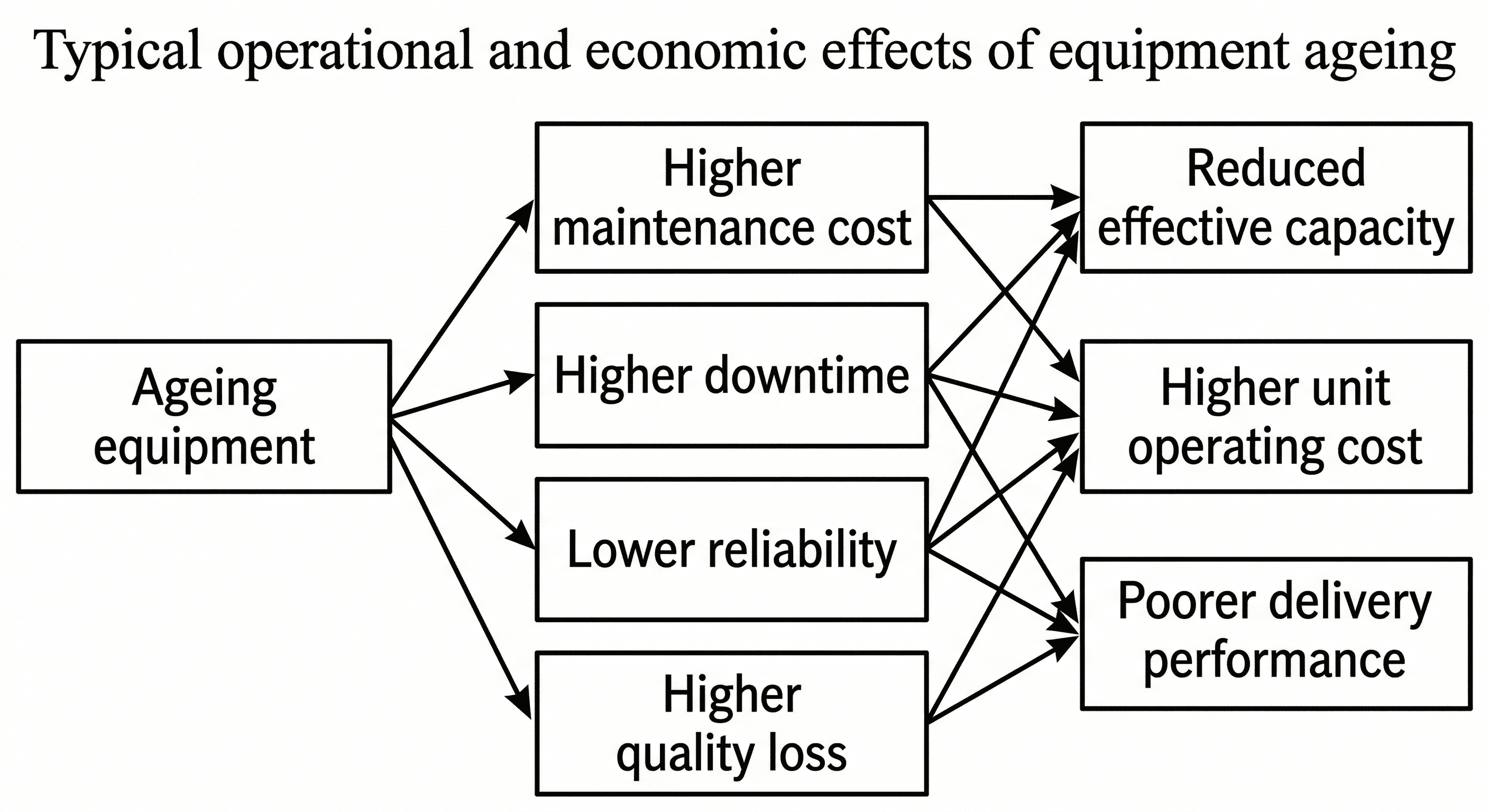
Ageing industrial assets create a recurring production-systems trade-off: early replacement can waste useful capital and service life, while late replacement can increase maintenance cost, downtime, quality losses, and delivery risk. This academic report studies replacement as an economic and operational decision rather than a maintenance-age rule.
The analysis compares three published real-world perspectives: the Texas Department of Transportation's fleet-scale replacement methodology, an EUAC and benefit-based road-tanker service-life study, and a gold-mining conveyor-belt dynamic-programming model. Their complementary strengths are synthesized into a Unified Ageing Equipment Replacement Scheme (UAERS) for plants, fleets, and material-handling systems.
UAERS is intended to make replacement recommendations more transparent and budget-aware by connecting economic-life estimation, portfolio ranking, and stronger policy analysis for high-consequence assets. It is a structured academic synthesis and proposed decision framework, not a peer-reviewed research contribution or a deployed production system.
The Core Systems Problem
- Replacement decisions must balance rising operating and repair costs, declining salvage value, downtime and production losses, safety or criticality constraints, and alternative uses of capital.
- A minimum-cost replacement age for one asset does not answer which units should be replaced first when a fleet or plant operates under an annual capital budget.
- Critical assets require repeated keep-or-replace reasoning as age-dependent revenue, operating cost, salvage value, and failure consequences evolve over a planning horizon.
My Specific Technical Contributions
- Reviewed and compared three published replacement-analysis case studies across fleet, asset-class, and critical-asset decision levels.
- Synthesized TxDOT life-cycle cost trends and class-wise ranking, road-tanker EUAC service-life analysis, and conveyor-belt dynamic programming into the three-layer UAERS framework.
- Defined a practical workflow spanning asset classification, data assembly, economic-life estimation, priority ranking, critical-asset analysis, budget-constrained selection, and periodic review.
- Reproduced the report's annualized-cost logic and a staged keep-or-replace calculation from the mining case, while identifying discount rate, downtime cost, and maintenance escalation as required sensitivity variables.
Replacement-Analysis Framework
Case I: TxDOT fleet prioritization
Uses life-cycle cost histories and a trend score to produce auditable, class-wise replacement rankings for a fleet of more than 17,100 units under annual budget constraints.
Case II: Road-tanker economic life
Applies EUAC and benefit-based criteria to a fleet of more than 500 similar trucks. The studied context reports an economically justified cut-off near 1 million kilometres, or about six years, with strong sensitivity to the real discount rate.
Case III: Conveyor staged policy
Models conveyor-belt age as the state in a five-year dynamic program. For the reported mining economics, the keep-or-replace solution favours yearly replacement, with the conclusion strengthening as operating cost rises.
UAERS: Three decision layers
Layer 1 estimates economic life through annualized cost; Layer 2 ranks portfolio candidates using cost trend, downtime, repair burden, and criticality; Layer 3 applies dynamic programming or risk-adjusted EUAC to critical assets.
Design Decisions & Engineering Trade-Offs
Technical Stack & Tools
Known Limitations
- UAERS depends on reliable age-wise operating, maintenance, downtime, salvage, and usage data; many organizations do not yet record all of these consistently.
- The proposed priority-score weights require managerial judgement and validation against the organization's operational objectives.
- The framework does not develop a predictive-maintenance or real-time condition-monitoring model, and full dynamic programming is appropriate only where detailed age-based economics are available.
- The reported six-year tanker and yearly conveyor policies are case-specific findings from the reviewed studies, not universal replacement rules.
What I Would Test Next
- Formulate budget-constrained portfolio selection as an explicit optimization model.
- Connect the risk-adjusted layer to reliability and condition-monitoring estimates of failure probability.
- Integrate replacement timing with production-capacity and delivery-performance planning.
Connected Systems & Inquiries
Connecting component-level lifecycle emissions with persistent product state for circular electronics refurbishment.
Demonstrating why prediction accuracy alone does not guarantee operational actionability in industrial supply chain ML.