
RefurbCarbon: Circular Electronics Lifecycle Intelligence
Connecting component-level lifecycle emissions with persistent product state for circular electronics refurbishment.
Overview & Research Motivation
Supported by the NITT Undergraduate Research Fellowship and aligning with Government of India sustainability initiatives, RefurbCarbon models the complete carbon footprint and circular lifecycle of refurbished electronics.
Refurbished electronic devices have complex, non-linear lifecycles involving diagnostic testing, component replacement, workshop energy consumption, logistics, and extended second-life use phases. RefurbCarbon establishes a computational accounting framework grounded in ISO 14040/14044 Life Cycle Assessment (LCA) standards, the GHG Protocol Product Standard, and the IDEMAT LCI database.
The framework assigns a persistent 12N QR-based Digital Product Passport (DPP) to every refurbished unit, encoding bill-of-materials provenance, refurbished component carbon deltas, and verified emissions savings compared to virgin manufacturing.
The Core Systems Problem
- Consumers and corporate buyers lack verifiable proof regarding the true environmental footprint and carbon savings of refurbished electronics versus new equipment.
- Refurbishment MSMEs lack automated engineering tools to calculate component-level Scope 1, 2, and 3 emissions without hiring expensive environmental consultancy firms.
Why I Worked on It
"As a Production Engineering student, I wanted to apply rigorous industrial engineering and LCA methodologies to create an open, auditable digital infrastructure for the circular economy."
My Specific Technical Contributions
- Formulated mathematical lifecycle carbon calculation models covering raw materials, transportation, refurbishment workshop electricity, and secondary use phases.
- Integrated IDEMAT and international LCI datasets for electronic components (displays, batteries, logic boards).
- Architected the 12N QR Digital Product Passport data model linking physical device serials to environmental provenance records.
- Conducted field case studies on mobile and computing refurbishment workflows in Indian MSME environments.
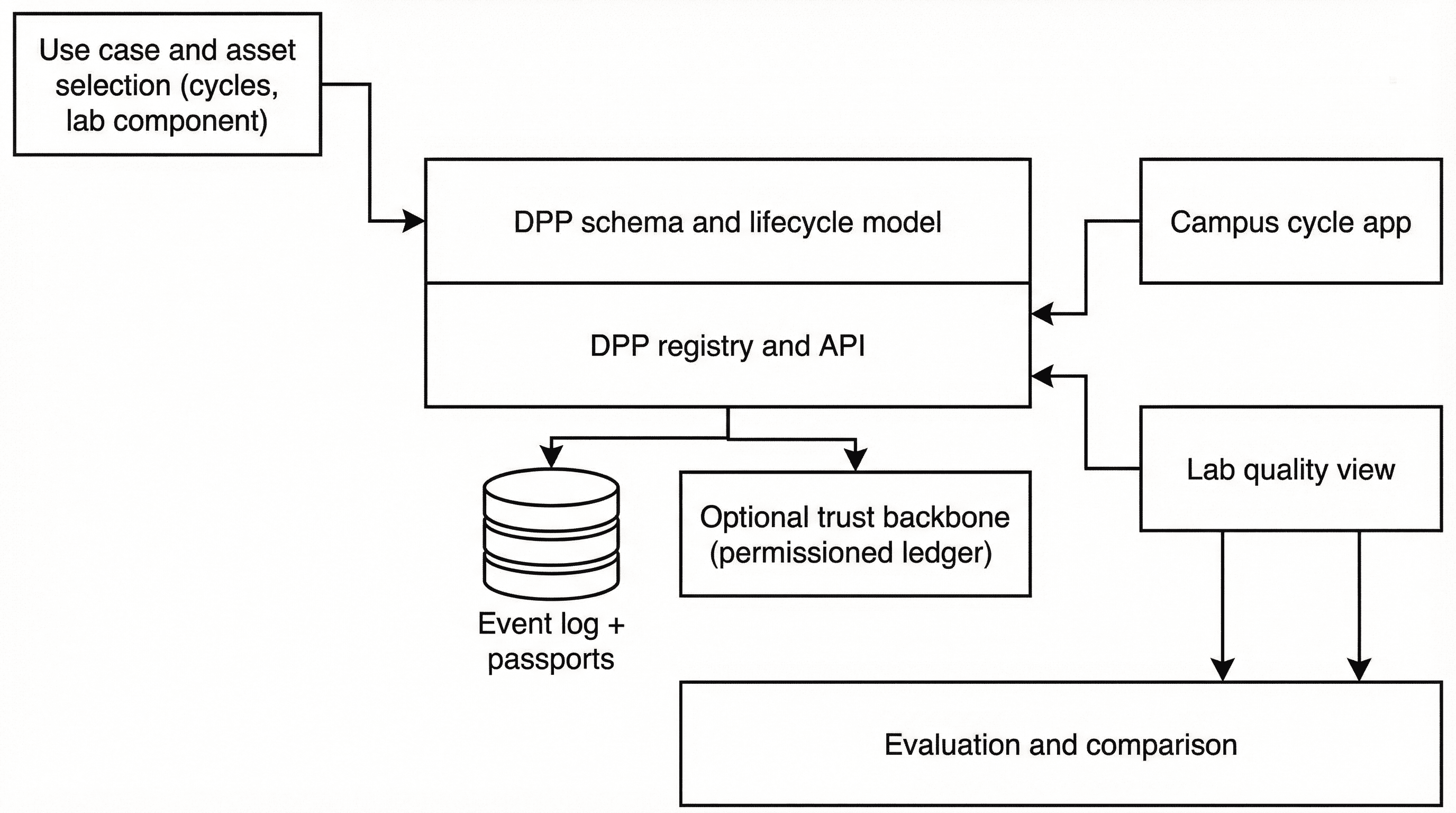
System Architecture & Verification Pipeline
LCA Computational Engine
Calculates Scope 1, 2, and 3 emissions across refurbishment stages based on ISO 14040/14044 and GHG Protocol formulas.
12N QR Digital Product Passport
Encodes persistent device identity and component replacement history, accessible via standard mobile scanners.
MSME Shopfloor Ingestion Interface
Captures technician replacement logs, workshop energy meter readings, and shipment logistics into structured emission ledgers.
Evaluation & Benchmark Results
Technical Stack & Tools
Known Limitations
- LCI dataset accuracy depends on geographic energy grid emission factors; regional Indian grid emission factors require ongoing calibration.
What I Would Test Next
- Integrating automated testing bench sensor readings directly into the DPP generation pipeline.
- Publishing empirical lifecycle assessment findings in a peer-reviewed cleaner production journal.
Connected Systems & Inquiries
Structuring reusable DLT design knowledge into an Open Knowledge Format (OKF) and operationalizing it for cross-marketplace identity and trust.
A privacy-preserving mobility data architecture for independently verifiable vehicle lifecycle state without central data silos.
Demonstrating why prediction accuracy alone does not guarantee operational actionability in industrial supply chain ML.