
Industrial IoT Predictive Maintenance
A sensor prototype and designed analytics pipeline for condition monitoring of industrial motors and pumps.
Overview & Research Motivation
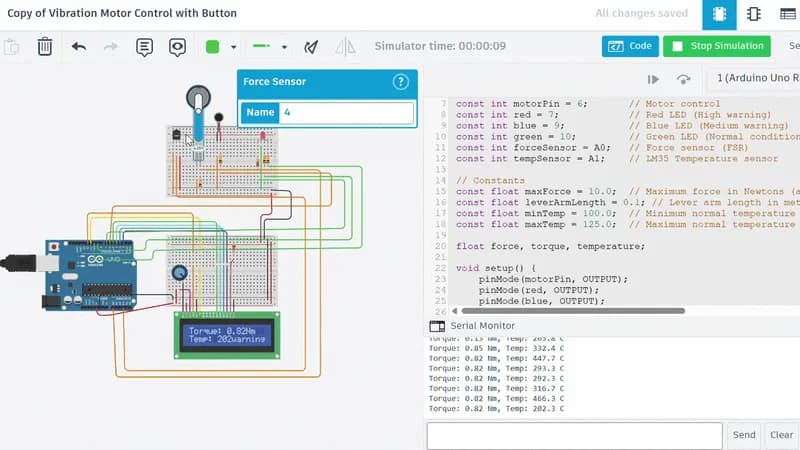
This academic cyber-physical prototype models condition monitoring for rotating equipment such as industrial motors and pumps. The implemented Tinkercad/Arduino sensing stack combines vibration, temperature, force, voltage, and speed/RPM inputs to make equipment state observable during operation.
Alongside the sensor prototype, I designed an analytics pipeline covering acquisition, filtering and noise reduction, normalization, RMS, kurtosis and spectral feature extraction, health classification, anomaly detection, and remaining-useful-life regression concepts. Time-series ingestion, monitoring dashboards, and potential edge/SCADA integration are architectural extensions rather than claims that every predictive model was implemented.
The Core Systems Problem
- Unexpected motor failure in industrial plant environments can cause costly production downtime, while commercial predictive-maintenance systems may be difficult for small-scale manufacturing facilities to adopt.
My Specific Technical Contributions
- Prototyped the Arduino/Tinkercad sensing model for vibration, temperature, force, voltage, and rotational-speed signals.
- Designed the signal-processing workflow for noise reduction, normalization, and time- and frequency-domain feature extraction.
- Specified the intended time-series, dashboard, health-classification, anomaly-detection, and RUL-analysis pipeline while keeping it distinct from the implemented sensor prototype.
System Architecture & Verification Pipeline
Implemented Sensor Prototype
Arduino/Tinkercad model representing vibration, temperature, force, voltage, and speed/RPM sensing for rotating equipment.
Digital Signal Processing
Designed filtering and normalization stages followed by RMS, kurtosis, and spectral-type feature extraction.
Intended Analytics & Monitoring Pipeline
Time-series ingestion and dashboards feed health classification, anomaly detection, and RUL/regression concepts, with possible edge and SCADA integration.
Technical Stack & Tools
Connected Systems & Inquiries
Exploring how evolving cyber-physical state can remain independently verifiable under privacy and adversarial constraints.
A permissioned Cosmos SDK ledger for connecting supply chain state with MES and digital twin telemetry.
Encountered-type haptics system coordinating distributed mobile robotic units for realistic tactile feedback in VR.