
Latch: Policy-Bounded Agent Commerce
Preventing AI buyer agents from blindly racing checkout flows through deterministic spending policy enforcement.
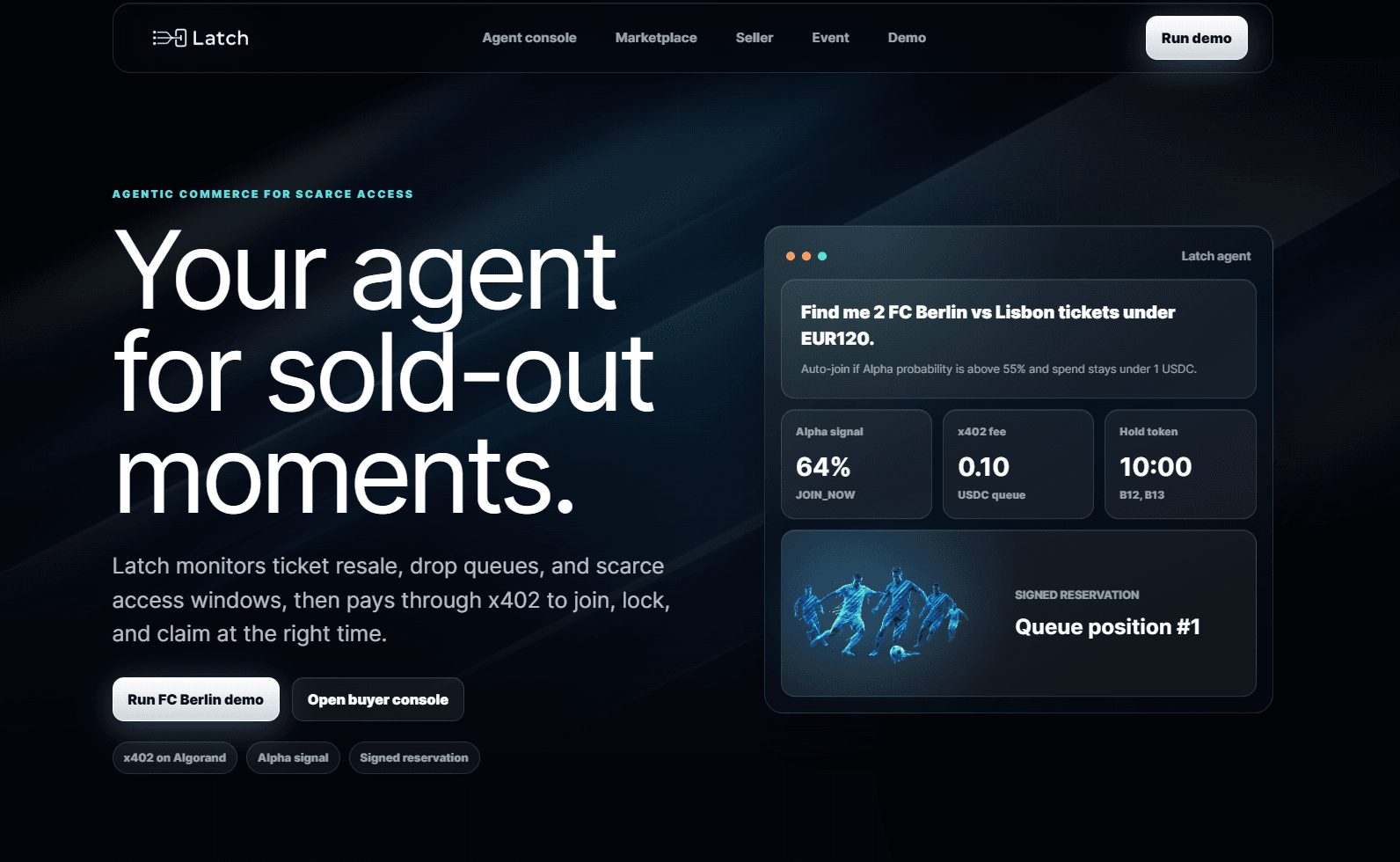
Overview & Research Motivation
As AI shopping and booking agents proliferate, unconstrained agents racing checkout endpoints cause inventory exhaustion and unauthorized spending. Latch introduces an agent-native fair-access protocol combining HTTP-native x402 payment headers, Algorand TestNet settlement, and signed reservation queue tokens.
Crucially, the LLM agent is never permitted to unilaterally authorize financial transactions. A deterministic local policy engine strictly evaluates spending caps, rate limits, and market signals (from Alpha Arcade) before issuing HMAC-signed queue claims.
The Core Systems Problem
- Autonomous agents equipped with payment keys can easily overspend or fall prey to deceptive checkout endpoints without deterministic policy guardrails.
My Specific Technical Contributions
- Engineered the x402 HTTP payment negotiation middleware in Hono and Node.js.
- Designed the deterministic spending policy engine evaluating transaction limits independently of LLM prompt context.
- Implemented signed hold token and reservation queue verification on Algorand TestNet.
System Architecture & Verification Pipeline
x402 Negotiation Middleware
Handles HTTP 402 Payment Required status codes and executes micropayment handshakes seamlessly.
Deterministic Policy Guardrail
Evaluates hardcoded spending limits and vendor reputation before any payment payload is constructed.
Algorand Signed Queue Tokens
Mints verifiable reservation receipts ensuring fair inventory allocation during high-demand sales.
Technical Stack & Tools
Connected Systems & Inquiries
A multi-agent decision architecture where specialized agents deliberate before constrained, user-authorized execution.
An experiment in enforcing cryptographic trust boundaries so generative AI cannot silently redefine canonical game state.
A policy and finance-operations guardrail for x402-enabled autonomous machine payments.