
DLT Knowledge DSS & Cross-Marketplace Trust
Structuring reusable DLT design knowledge into an Open Knowledge Format (OKF) and operationalizing it for cross-marketplace identity and trust.
Overview & Research Motivation
Design-science knowledge for distributed ledger systems is fragmented across hundreds of academic papers, industry whitepapers, and technical specifications, making it difficult to reuse systematically. At the Information Systems Institute (Universität Leipzig), I developed a researcher-facing decision-support system (DSS) for structuring, querying, and synthesizing DLT design knowledge.
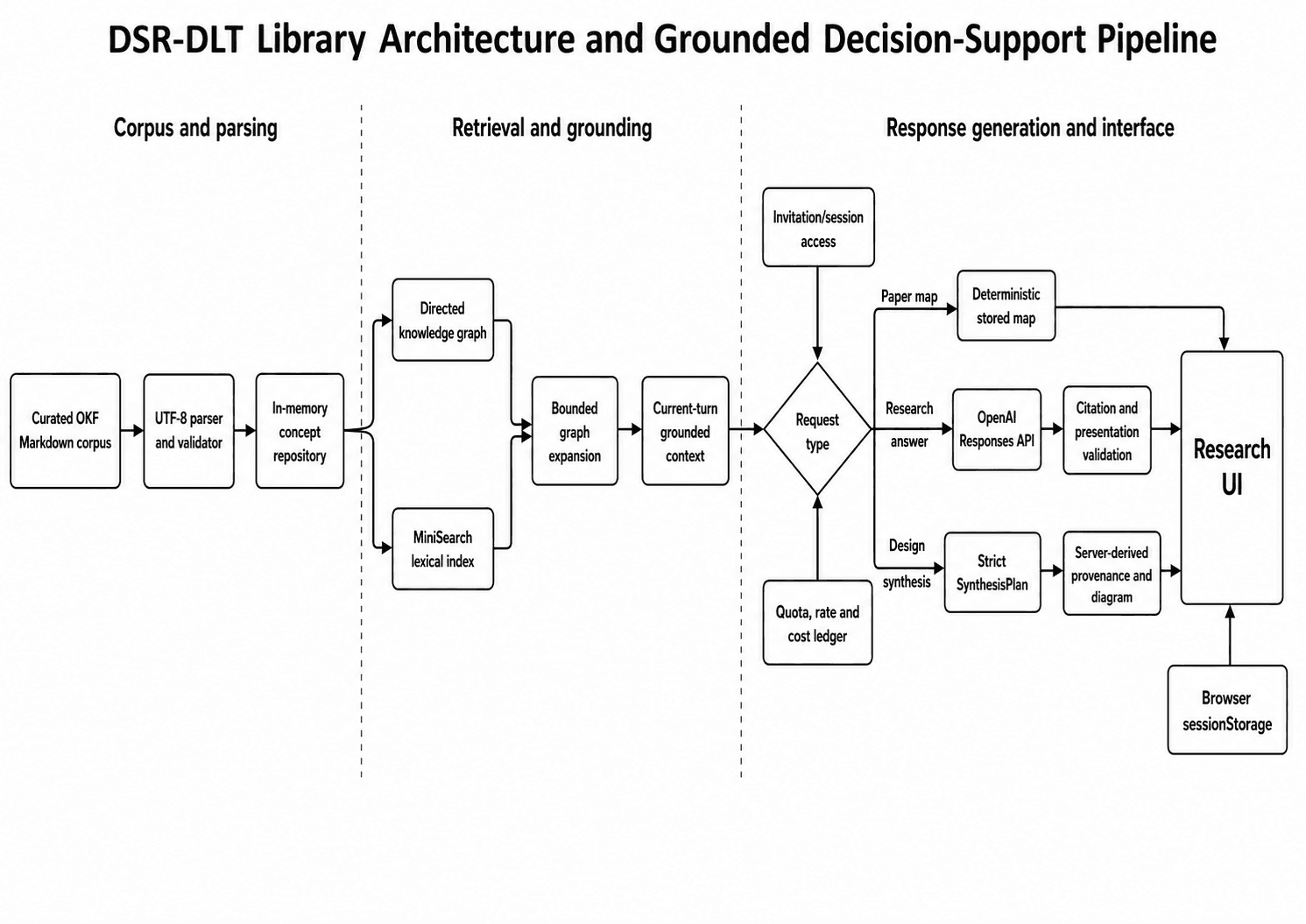
The workbench replaces opaque vector embeddings with a native Open Knowledge Format (OKF), graph-structured concept representation, deterministic multi-stage lexical and structural retrieval, and provenance-bound context for evidence-grounded synthesis. I then operationalized these design principles to design a decentralized product registry addressing listing fragmentation, counterfeit risk, and review state across e-commerce marketplaces using GS1 Digital Link, GTIN, and ECLASS standards.
The Core Systems Problem
- Standard vector-only RAG approaches discard critical structural relationships, hierarchical taxonomy, and citation provenance, hallucinating architectural recommendations for distributed systems.
- In global e-commerce, identical physical products exist under fragmented, incompatible marketplace representations with isolated seller reputations, untraceable supply chains, and duplicate product data.
Why I Worked on It
"I wanted to test whether we could capture nuanced architectural design science without reducing academic literature to disjoint text chunks, and immediately prove the utility of that knowledge on a difficult real-world information systems challenge."
My Specific Technical Contributions
- Architected the Open Knowledge Format (OKF) schema with multi-tier concept hierarchies and explicit architectural relationship mappings.
- Designed and deployed the deterministic graph retrieval engine combining lexical search, typed relationship traversals, and citation tracking.
- Formulated the cross-marketplace product registry architecture utilizing GS1 Digital Link, GTIN identifiers, and ECLASS classifications.
- Built the interactive researcher-facing exploration UI deployed live at dsr-library.org.
System Architecture & Verification Pipeline
OKF Knowledge Representation
Decomposes DLT literature into structured design artifacts, architectural trade-offs, formal evaluation models, and boundary conditions with explicit entity-relationship graphs.
Deterministic Hybrid Retrieval
Executes typed graph queries paired with BM25 lexical ranking and concept-neighbourhood traversals, ensuring zero ungrounded context injection.
Cross-Marketplace Trust Registry
Decentralized state layer anchoring verifiable claims for product specifications, verified reviews, and merchant credentials mapped via GS1 Digital Link.
Design Decisions & Engineering Trade-Offs
Technical Stack & Tools
Known Limitations
- Current ontology extraction requires manual validation for edge-case DLT consensus mechanisms.
- Cross-marketplace smart contract settlement layer evaluated on test environments; full mainnet deployment pending pilot partner onboarding.
What I Would Test Next
- Expanding automated ingestion pipelines with self-supervised verification checks against canonical standards.
- Evaluating multi-party dispute resolution protocols on simulated adversarial marketplace state transitions.
Connected Systems & Inquiries
A privacy-preserving mobility data architecture for independently verifiable vehicle lifecycle state without central data silos.
Connecting component-level lifecycle emissions with persistent product state for circular electronics refurbishment.
A permissioned Cosmos SDK ledger for connecting supply chain state with MES and digital twin telemetry.