
VehiclePassport: GAIA-X & ZK Mobility Passport
A privacy-preserving mobility data architecture for independently verifiable vehicle lifecycle state without central data silos.
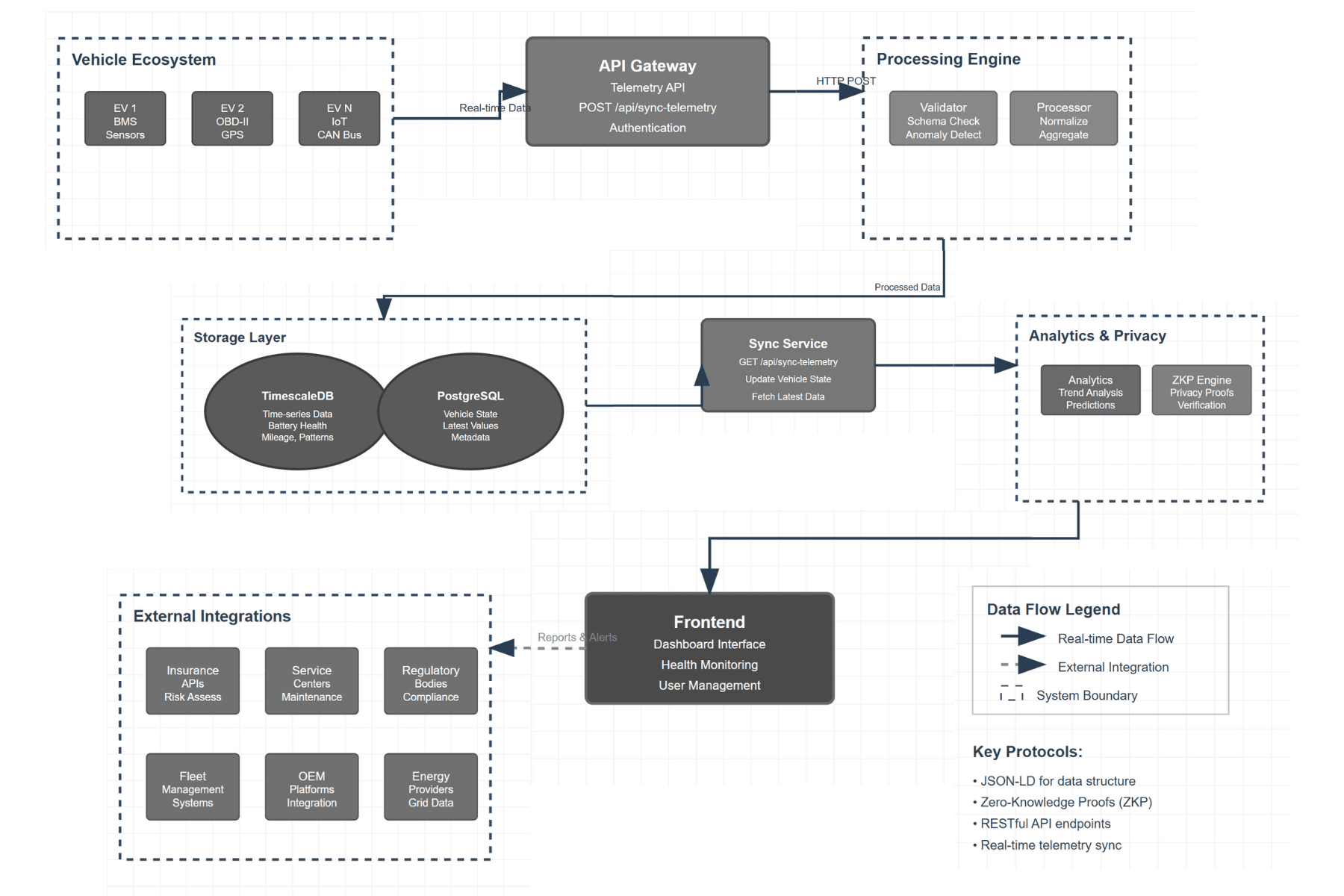
Overview & Research Motivation
Vehicle lifecycle information is fragmented across OEMs, owners, service centers, insurers, infrastructure operators, and downstream buyers. Existing data silos prevent transparent verification of battery health, mileage, and maintenance provenance, while indiscriminate data sharing creates severe privacy and corporate data sovereignty issues.
In this public research preprint (arXiv:2509.06133), I architected VehiclePassport, a standards-aware mobility data framework aligning with GAIA-X self-descriptions, JSON-LD schemas, W3C Verifiable Credentials, Polygon zkEVM blockchain anchoring, and zero-knowledge selective disclosure.
Crucially, the system keeps raw, sensitive telemetry completely off-chain in TimescaleDB/PostgreSQL instances. Only cryptographic commitments and integrity hashes are anchored to the blockchain, allowing stakeholders to generate and verify ZK proofs regarding vehicle properties (e.g. 'Battery State-of-Health > 85%' or 'Service interval adhered to') without exposing continuous location traces or raw telemetry.
The Core Systems Problem
- Centralized mobility databases expose granular driver location history and proprietary OEM battery telemetry to third parties.
- Secondary buyers and insurers cannot verify whether a vehicle's odometer has been tampered with or if critical warranty battery replacements occurred.
Why I Worked on It
"Working on EV telemetry pipelines made me realize that 'putting vehicle data on blockchain' is fundamentally broken. The only viable solution is off-chain sovereign storage paired with on-chain cryptographic anchoring and zero-knowledge verification."
My Specific Technical Contributions
- Architected the full system topology: ingestion pipeline, off-chain sovereign datastores, JSON-LD credential schemas, and smart contract anchoring.
- Designed zero-knowledge verification circuits for range, odometer thresholds, and battery degradation checks.
- Benchmarked high-throughput 1 Hz telemetry workloads simulating 1,000,000 connected vehicles.
- Authored and published the complete independent preprint on arXiv (arXiv:2509.06133).
System Architecture & Verification Pipeline
Telemetry Ingestion & Off-Chain Storage
HMAC-authenticated vehicle gateways stream 1 Hz telemetry into partitioned TimescaleDB/PostgreSQL clusters; raw time-series data never touches the ledger.
Cryptographic Commitment Layer
Batched state hashes and lifecycle milestone Merkle roots are committed to Polygon zkEVM smart contracts with minimal gas expenditure.
Selective Disclosure & ZK Proof Engine
Vehicle owners generate W3C Verifiable Presentations and client-side ZK proofs to prove specific compliance predicates to insurers or buyers without disclosing raw logs.
Field-Scoped Access Delegation
Short-lived, cryptographically-signed JWT access tokens allow authorized service centers to perform verified state mutations.
Design Decisions & Engineering Trade-Offs
Evaluation & Benchmark Results
Technical Stack & Tools
Known Limitations
- Hardware-enforced Secure Enclave (HSM) attestation inside vehicle ECUs assumed in paper model; physical tamper-proofing requires OEM hardware root-of-trust integration.
What I Would Test Next
- Integrating dynamic battery degradation mathematical models into automated ZK-proof generation pipelines.
- Expanding interoperability pilots across Catena-X data space testbeds.
Connected Systems & Inquiries
Exploring how evolving cyber-physical state can remain independently verifiable under privacy and adversarial constraints.
Connecting component-level lifecycle emissions with persistent product state for circular electronics refurbishment.
A permissioned Cosmos SDK ledger for connecting supply chain state with MES and digital twin telemetry.